
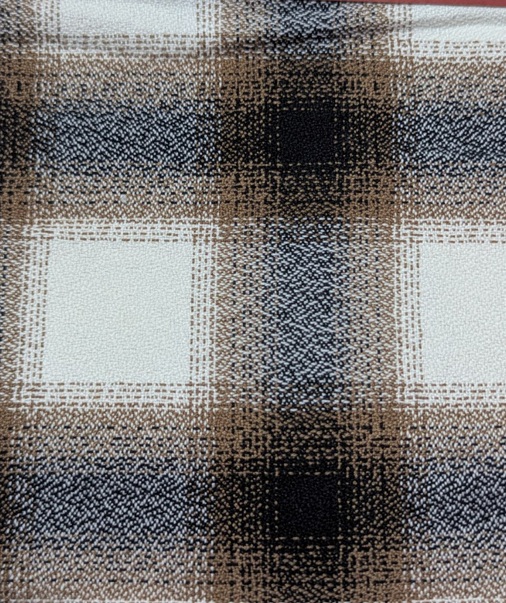
Crepe is a textured textile distinguished by its crinkled, pebbled, or slightly wrinkled surface effect created through the use of high-twist yarns or specialized finishing techniques. Traditionally produced from silk, wool, cotton, or synthetic fibers, crepe is valued for its fluid drape, soft hand feel, and subtle surface irregularity that enhances depth and movement in garments.
Crepe is typically constructed using tightly twisted yarns—commonly alternating S-twist and Z-twist—in plain, twill, or satin weave bases. The high twist level generates internal yarn tension which, upon finishing and relaxation, produces the characteristic granular texture. The fabric generally ranges from lightweight to medium weight, approximately 80–280 GSM, depending on fiber composition and intended application. Its surface appears matte to semi-lustrous, with excellent drape performance and moderate elasticity due to yarn torque.
The texture may also be achieved or enhanced through mechanical crinkling, chemical treatment, embossing, or heat-setting processes, particularly in polyester-based crepes. Variations such as crepe de chine, georgette crepe, wool crepe, and polyester crepe differ in transparency, density, and structural resilience.
Historically, crepe gained prominence in Europe and Asia during the 19th century, especially in silk-based formal and ceremonial garments. Over time, it transitioned into mainstream global fashion, becoming widely used for dresses, blouses, scarves, and elegant womenswear silhouettes. Its flowing structure made it particularly suitable for garments requiring movement and softness.
Common finishing processes include piece dyeing, softening, heat-setting (for synthetics), and shrinkage control treatments. These processes stabilize the twisted yarns and preserve the distinctive surface texture while improving dimensional stability and durability.
Crepe is widely used in dresses, blouses, sarees, scarves, formalwear, and contemporary fashion garments where drape and texture are essential design elements. Wool crepe variants are also applied in tailored garments due to their resilience and wrinkle recovery properties.
In a textile museum context, crepe exemplifies how yarn engineering—specifically twist manipulation—can transform a simple weave into a visually dynamic fabric. It represents the technical interplay between yarn tension, finishing processes, and surface morphology, demonstrating how structural control creates aesthetic sophistication without complex weave patterns.