
By Texheritage Bangladesh: Museum, Innovation & Preservation
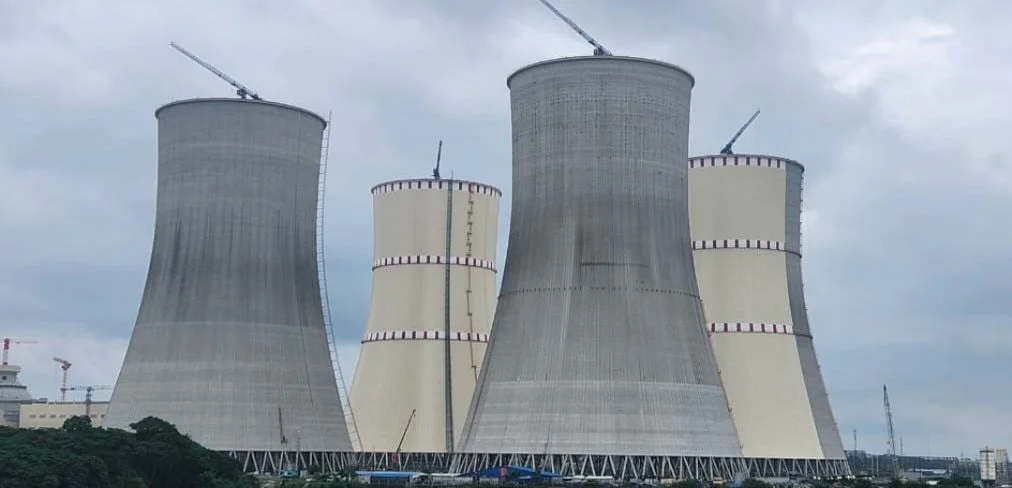
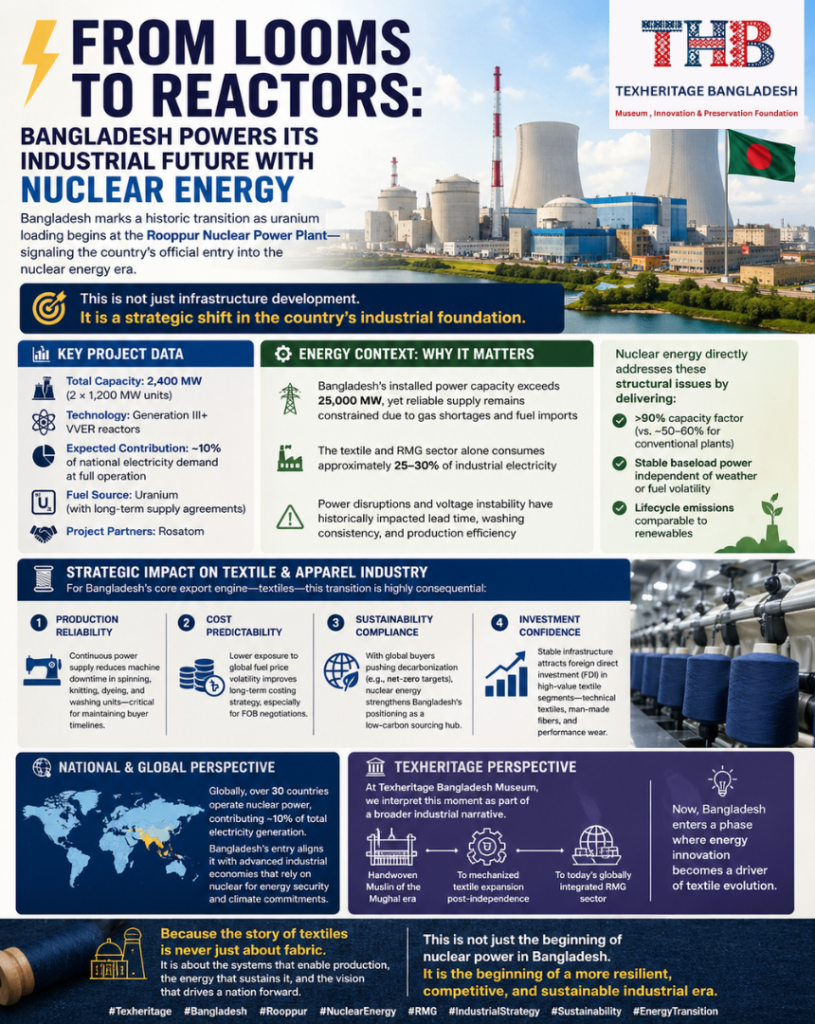
Bangladesh marks a historic transition as uranium loading begins at the Rooppur Nuclear Power Plant—signaling the country’s official entry into the nuclear energy era.
This is not just infrastructure development.
It is a strategic shift in the country’s industrial foundation.
Key Project Data
- Total Capacity: 2,400 MW (2 × 1,200 MW units)
- Technology: Generation III+ VVER reactors
- Expected Contribution: ~10% of national electricity demand at full operation
- Fuel Source: Uranium (with long-term supply agreements)
- Project Partners:
Energy Context: Why It Matters
- Bangladesh’s installed power capacity exceeds 25,000 MW, yet reliable supply remains constrained due to gas shortages and fuel imports
- The textile and RMG sector alone consumes approximately 25–30% of industrial electricity
- Power disruptions and voltage instability have historically impacted lead time, washing consistency, and production efficiency
Nuclear energy directly addresses these structural issues by delivering:
- >90% capacity factor (vs. ~50–60% for conventional plants)
- Stable baseload power independent of weather or fuel volatility
- Lifecycle emissions comparable to renewables
Strategic Impact on Textile & Apparel Industry
For Bangladesh’s core export engine—textiles—this transition is highly consequential:
1. Production Reliability
Continuous power supply reduces machine downtime in spinning, knitting, dyeing, and washing units—critical for maintaining buyer timelines.
2. Cost Predictability
Lower exposure to global fuel price volatility improves long-term costing strategy, especially for FOB negotiations.
3. Sustainability Compliance
With global buyers pushing decarbonization (e.g., net-zero targets), nuclear energy strengthens Bangladesh’s positioning as a low-carbon sourcing hub.
4. Investment Confidence
Stable infrastructure attracts foreign direct investment (FDI) in high-value textile segments—technical textiles, man-made fibers, and performance wear.
National & Global Perspective
Globally, 33 countries including Bangladesh operate nuclear power, contributing ~10% of total electricity generation. Bangladesh’s entry aligns it with advanced industrial economies that rely on nuclear for energy security and climate commitments.
Texheritage Perspective
At Texheritage Bangladesh Museum, we interpret this moment as part of a broader industrial narrative.
From:
- Handwoven Muslin of the Mughal era
- To mechanized textile expansion post-independence
- To today’s globally integrated RMG sector
Now, Bangladesh enters a phase where energy innovation becomes a driver of textile evolution.
Because the story of textiles is never just about fabric.
It is about the systems that enable production, the energy that sustains it, and the vision that drives a nation forward.
This is not just the beginning of nuclear power in Bangladesh.
It is the beginning of a more resilient, competitive, and sustainable industrial era.