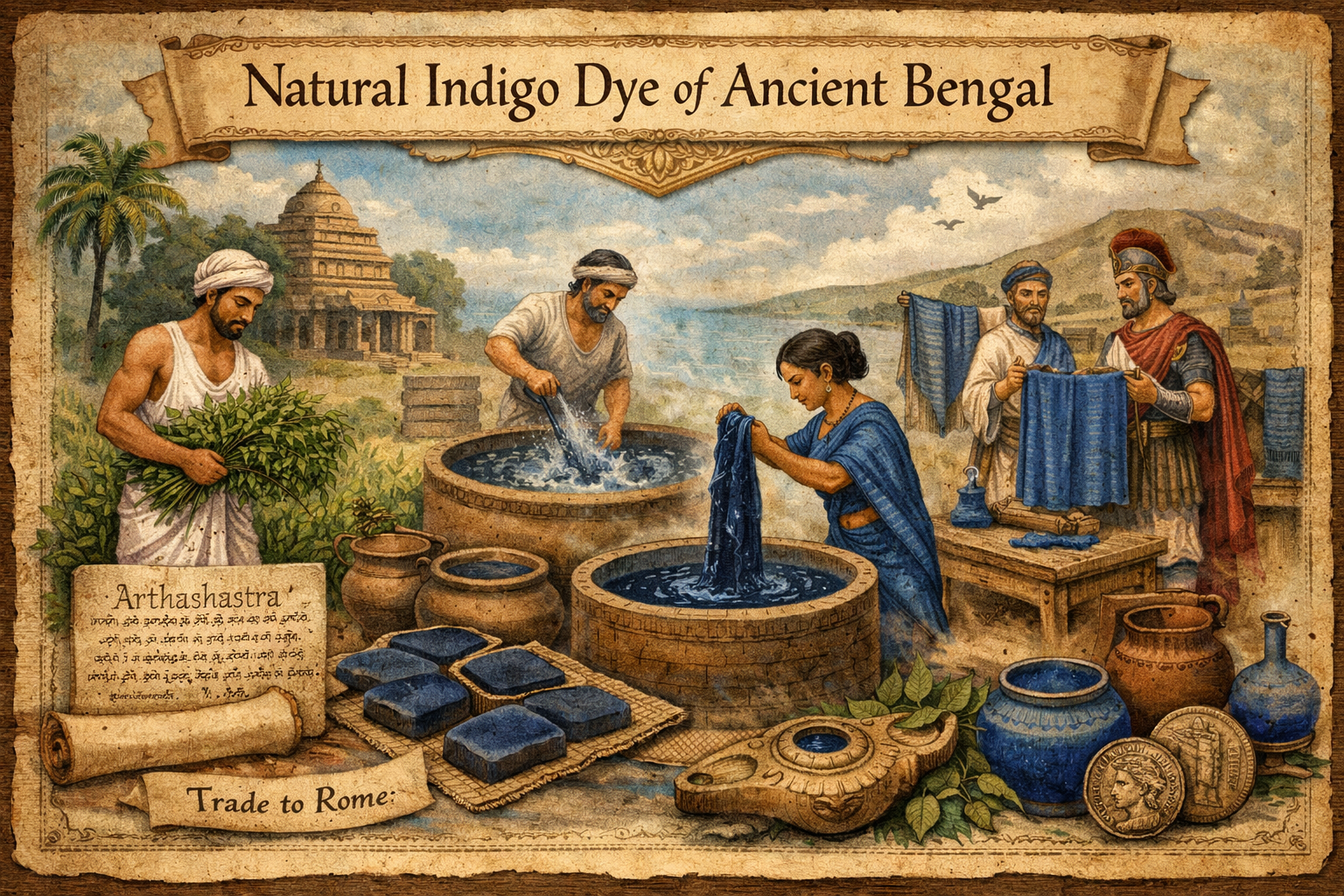
Long before synthetic dyes transformed the textile world, natural indigo from Indigofera tinctoria was one of the most complex and economically vital colorants in global trade. In Bengal, indigo dyeing was more than a craft—it was a sophisticated integration of agriculture, fermentation chemistry, dye engineering, and trade logistics, influencing livelihoods across Asia, Africa, and Europe. Beyond color, indigo became a strategic industrial raw material, a regulated cash crop, and a tool of colonial control.
Ancient Origins: Indigo Technology in Bengal (Before 500 CE)
Bengal’s indigo story stretches over two millennia. Archaeological, botanical, and textual evidence points to highly organized production systems:
- 4th century BCE: The Arthashastra references blue-dyed textiles and regulated dye substances.
- 1st–4th century CE: Roman trade documents confirm indigo imports from the subcontinent.
Technical practices included:
- Cultivation in alluvial river plains
- Harvesting leaves at peak indican concentration
- Fermentation converting indican to indoxyl
- Oxidation and precipitation to produce indigo cakes
Bengal’s humid climate, warm temperatures, and mineral-rich river water produced high-purity indigo cakes, making the region one of Asia’s most reliable producers.
Medieval Expansion: Sultanate & Mughal Indigo Systems (1204–1757)
Under the Delhi Sultanate and Mughal Empire, indigo evolved from localized craft to state-regulated proto-industry.
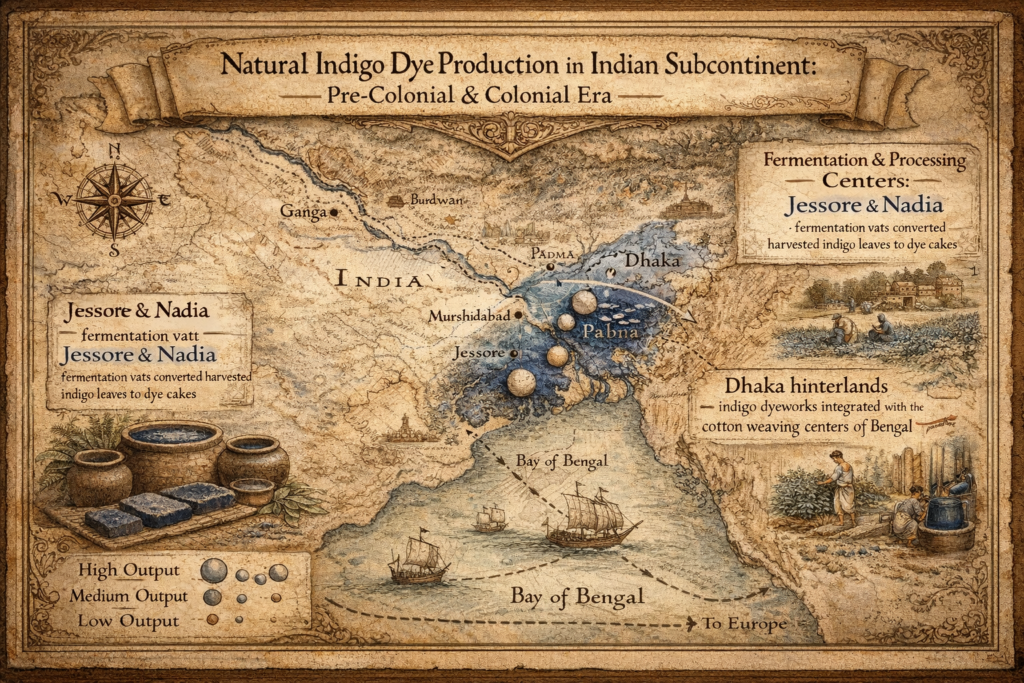
Major production zones:
- Jessore & Nadia – fermentation and processing centers
- Rajshahi & Pabna – large-scale cultivation regions
- Dhaka hinterlands – integration with cotton weaving zones
Key features:
- Earthen fermentation vats (precursors to neel kothi)
- Standardized dye cakes by weight and grade
- Monitored export commodity in Mughal revenue records
By the 17th century, Bengal indigo supplied Persian, Ottoman, and European markets. European dyers prized it for high pigment concentration, oxidation stability, and fiber affinity.
Colonial Intensification: Plantation Indigo (1757–1859)
After the Battle of Plassey (1757), indigo production became a plantation-based system under British control.
Changes under colonial rule:
- Expansion of indigo estates (nil kuthis)
- Industrial-scale fermentation replacing artisanal methods
- Emphasis on yield over dye quality
- Soil depletion from monoculture cropping
Social impact:
- Farmers tied to coercive contracts
- Displacement of food crops and agrarian instability
- Local knowledge transferred from artisans to European planters
Indigo shifted from craft-based technology to industrial commodity, fueling global trade and colonial profits.
The Indigo Revolt: Resistance Through Technology (1859–1860)
The Indigo Revolt (Nil Bidroho) was a protest against forced production and exploitative technology:
- Mass refusal to cultivate indigo in Nadia and Jessore
- Sabotage of plantations and fermentation supplies
- Support from Bengali press and intellectuals
Outcome:
- 1860 Indigo Commission documented systemic abuse
- Gradual collapse of plantation indigo
- One of South Asia’s earliest industrial resistance movements
Decline of Natural Indigo: Chemical Synthesis (1897–1910)
Bengal’s indigo industry could not compete with European science:
- 1897: Adolf von Baeyer synthesizes indigo chemically
- 1900–1910: Synthetic indigo dominates global markets
Advantages of synthetic indigo:
- Consistent purity and color
- Lower cost and faster processing
- Industrial compatibility
By 1910, Bengal’s centuries-old fermentation-based system had nearly vanished.
Why Bengal Indigo Matters Today
Bengal indigo represents:
- Early textile chemistry innovation
- Integrated agriculture, microbiology, and dye engineering
- A cautionary tale of industrial exploitation and knowledge loss
In modern times, bio-dyes, sustainable denim, and low-impact coloration draw lessons from this heritage.
Texheritage Bangladesh & Indigo Documentation
Texheritage Bangladesh preserves indigo’s history—from ancient fermentation to colonial extraction and modern sustainability. Through:
- Fabric samples
- Pigment studies
- Process documentation
- Archival research
…the museum reconnects Bengal’s indigo legacy with contemporary textile innovation.
Indigo is more than a dye.
It is chemistry, labor, resistance, and history—written in blue.