

A Historical and Industrial Analysis (1757–1947)
- Introduction
Textiles have long been central to Bengal’s cultural, economic, and technological identity. Prior to colonial intervention, the region stood as one of the world’s most advanced textile-producing centers. The advent of British colonial rule, however, introduced structural changes that permanently altered production systems, trade relations, and knowledge transmission. This article explores the mechanisms through which British colonial trade reshaped Bengal’s textile identity between 1757 and 1947.

- Bengal Before Colonial Intervention: A Global Textile Power (Pre-1757)
Before British dominance, Bengal occupied a commanding position in the global textile economy. From the sixteenth to the early eighteenth century, Bengali textiles were exported extensively to Europe, the Middle East, Africa, and Southeast Asia.
Key characteristics of pre-colonial Bengal textiles included:
- Ultra-fine muslin (malmal), with some varieties exceeding 1,000 thread count
- Sophisticated jamdani weaving, employing supplementary weft techniques
- Mastery of natural dyeing, including indigo, madder, lac, and turmeric
- Decentralized, artisan-led production systems rooted in hereditary skill transmission
European trading companies, including the British East India Company (established 1600), initially entered Bengal as commercial buyers rather than producers. By 1700, Bengal accounted for approximately 40 percent of Dutch textile imports and a substantial share of British textile imports into Europe (Riello, 2013).
- The Turning Point: British Control and Trade Monopoly (1757–1765)
The Battle of Plassey in 1757 marked a decisive transformation in Bengal’s political and economic landscape. With the consolidation of British power, Bengal’s textile economy shifted from a market-based artisanal system to a centrally controlled colonial economy.
Following the acquisition of Diwani rights in 1765, the East India Company gained authority over revenue collection and commercial regulation, enabling it to:
- Control textile pricing
- Impose advance contracts on weavers
- Penalize independent trade and private merchants
Archival records indicate that weavers were often compelled to sell textiles at prices 30–40 percent below prevailing market rates (Chaudhuri, 1978). These practices dismantled traditional guild structures and eliminated artisan autonomy.
- Deindustrialization of Indigenous Textile Production (Late 18th–19th Century)
4.1 Policy-Induced Decline
British trade and tariff policies played a central role in the deindustrialization of Bengal’s textile sector. While Indian textiles faced restrictions in Britain, British mill-produced textiles entered Indian markets with minimal duty.
Key policy developments included:
- The Calico Acts of 1700 and 1721, restricting Indian cotton imports into Britain
- Post-1813 liberalization allowing British textiles near duty-free entry into India
- Export of raw cotton from Bengal to fuel industrial production in Lancashire
As British industrial textiles flooded local markets, handwoven Bengal textiles rapidly lost price competitiveness.
4.2 Collapse of Artisan Livelihoods
Between 1800 and 1850, Bengal experienced a dramatic decline in professional handloom weaving. Contemporary accounts document entire weaving communities abandoning their craft due to economic distress (Roy, 2010). By the mid-nineteenth century, muslin—once Bengal’s most prestigious export—had virtually disappeared from global trade.
- Bengal as a Raw Material Periphery (Nineteenth Century)
Under colonial trade logic, Bengal was repositioned as a supplier of raw materials rather than value-added textile goods. Major exports included:
- Raw cotton
- Indigo, particularly from eastern Bengal
- Jute, which gained prominence in the late nineteenth century
The establishment of jute mills in Calcutta from 1855 exemplifies colonial industrial asymmetry. Although production facilities were located in Bengal, ownership, capital investment, and profit extraction remained overwhelmingly British. Textile value addition increasingly shifted away from indigenous knowledge systems toward imperial industrial centers.
- Cultural and Technical Knowledge Loss
Colonial restructuring affected not only production but also the transmission of textile knowledge. As weaving declined:
- Specialized techniques ceased to be practiced
- Natural dye formulations were lost
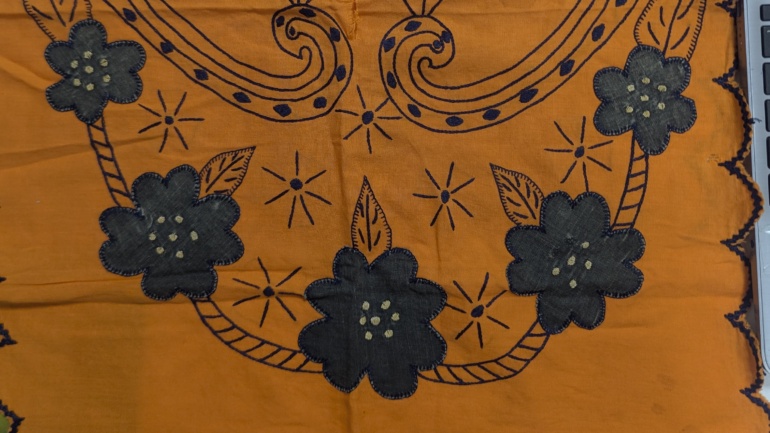
- Motif symbolism and design language lost intergenerational continuity
By the early twentieth century, many textile traditions survived only in fragmented oral histories or in museum collections located abroad, particularly in London and Europe. This rupture continues to affect textile education and design literacy in the region.
- Long-Term Legacy: From Colony to Garment Export Hub (1947–Present)
The structural legacy of British colonial trade laid the foundation for Bangladesh’s modern export-oriented textile economy. Since independence, the nation gradually transitioned from a historically artisanal textile producer to a global exporter of ready-made garments (RMG)—a shift rooted in industrial restructuring and global market integration. In recent years, this trajectory has continued, albeit with variations in growth and market performance that reflect global demand dynamics and competitive pressures.
In **2024, Bangladesh’s RMG exports reached approximately $38.48 billion, marking year-on-year growth and reaffirming the sector’s central role in the country’s export economy. The European Union remained the largest destination market, accounting for over half of total exports, followed by significant shipments to the United States and the United Kingdom.
During the 2024–25 fiscal period (July 2024 – June 2025), cumulative exports continued to grow, with preliminary data indicating robust earnings close to $39.35 billion, supported by increased knitwear and woven garment shipments.
However, early data from the 2025–26 fiscal year suggests emerging volatility. In the first six months (July–December 2025), RMG exports stood at about $19.36 billion, reflecting a modest decline compared with the previous period due to softening demand and competitive pricing pressures in key markets.
These figures highlight a complex contemporary landscape:
- The RMG sector remains the backbone of Bangladesh’s export economy, often constituting more than 80 % of manufactured export earnings.
- Export growth has seen both expansion and episodic contraction, shaped by global market conditions, unit-price adjustments, and shifting demand in traditional and non-traditional markets.
- Despite short-term fluctuations, Bangladesh retains a significant share in major markets such as the EU and USA, reflecting its entrenched role in global apparel supply chains.
The historical arc—from artisanal textile production to RMG export dominance—illustrates how colonial trade legacies and post-independence industrial strategies intersect. Understanding this evolution is essential for interpreting ongoing debates about sustainability, value-addition, product diversification, and heritage-informed innovation, particularly as stakeholders seek to balance export growth with cultural and technical revival initiatives spearheaded by institutions like Texheritage Bangladesh.
- Conclusion
British colonial trade reshaped Bengal’s textile identity through political domination, trade monopolization, tariff manipulation, and industrial displacement. The transformation was not solely economic but also cultural, technical, and epistemic. Recognizing this history allows Bangladesh to reimagine its textile future—not merely as a low-cost manufacturing hub, but as a region possessing deep and recoverable textile intelligence. In this process, textile museums and research archives play a critical role in reconstructing disrupted historical narratives.
References
Chaudhuri, K. N. (1978). The Trading World of Asia and the English East India Company, 1660–1760. Cambridge University Press.
Riello, G. (2013). Cotton: The Fabric that Made the Modern World. Cambridge University Press.
Roy, T. (2010). Traditional Industry in the Economy of Colonial India. Cambridge University Press.
Washbrook, D. (1981). Progress and Problems: South Asian Economic and Social History c. 1720–1860. Modern Asian Studies, 15(3).
Marshall, P. J. (1987). Bengal: The British Bridgehead. Cambridge University Press.
Habib, I. (1999). The Agrarian System of Mughal India. Oxford University Press.
Hunter, W. W. (1876). A Statistical Account of Bengal. Trübner & Co.